
Recession
On sale
12th March 2026
Price: £25
What causes a recession? Do recessions end on their own, or do they require external intervention? Does a recession in one country mean the rest of the world will follow? Are we in a recession now?
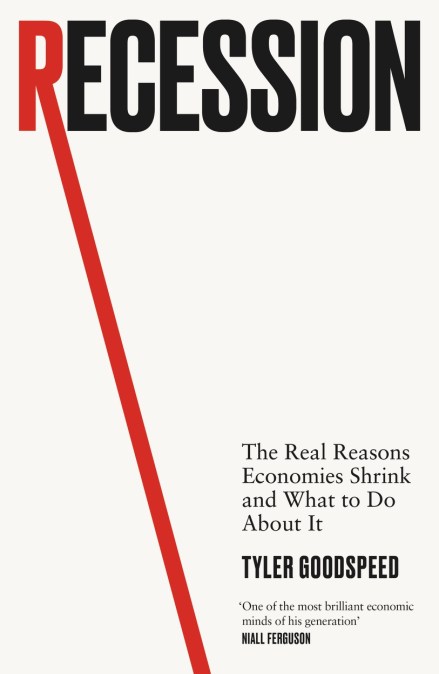
Economic expert Tyler Goodspeed answers these questions and many more in Recession, a groundbreaking new analysis of economic contractions over the last four centuries. Combining the historian’s extensive primary source material and the economist’s arsenal of statistical analysis, this book rewrites what we know about recessions. Contrary to popular perception, recessions are not the inevitable bust that follows an unsustainable boom, and they do not operate like wildfires that clear out economic deadwood. Recessions are caused by adverse shocks like war and energy price spikes, and far from unleashing gales of creative destruction, after a recession, economic growth typically resumes the same trend as before-all pain, no gain. While recessions have become less frequent over time, decisions made by businesses and governments can prolong recessions, and Goodspeed offers guidance to avoid making recessions worse. Issuing an important corrective to economic thinking, Recession is essential reading for high-level policymakers and armchair economists alike.
Economic expert Tyler Goodspeed answers these questions and many more in Recession, a groundbreaking new analysis of economic contractions over the last four centuries. Combining the historian’s extensive primary source material and the economist’s arsenal of statistical analysis, this book rewrites what we know about recessions. Contrary to popular perception, recessions are not the inevitable bust that follows an unsustainable boom, and they do not operate like wildfires that clear out economic deadwood. Recessions are caused by adverse shocks like war and energy price spikes, and far from unleashing gales of creative destruction, after a recession, economic growth typically resumes the same trend as before-all pain, no gain. While recessions have become less frequent over time, decisions made by businesses and governments can prolong recessions, and Goodspeed offers guidance to avoid making recessions worse. Issuing an important corrective to economic thinking, Recession is essential reading for high-level policymakers and armchair economists alike.
Reviews
A brilliant analysis of economic expansions and recessions over several centuries and countries - essential reading to understand today's challenges
It is rare that a work of economic history is truly revolutionary. Goodspeed's Recession is such a book . . . This extraordinary tour de force confirms Goodspeed as one of the most brilliant economic minds of his generation. No economic downturn - including the Great Depression itself - will ever look quite the same again
A deeply researched, engaging, and insightful look at the history of recessions in the US and UK. Suitable for researchers, students, and business economics enthusiasts alike
Recession is a captivating sequence of stories about the disparate shocks - involving imposters, grasshoppers, and wars - that explain recessions. And it is also an important counter to two unhistorical stories, one about the cyclical regularity of recessions and the other about their origin in the moral failures of antecedent expansions
Recession is a rigorous review, a very rewarding read, and a relevant recap of what we think we know (too much) and don't know (a lot) about economic downturns by solely fixating on post-WWII data on the US. By extending the domain of analysis back hundreds of years and by expanding the span to include a parallel study of UK slumps, the author does the economics profession and the reader a valuable service. A must-read for practitioners, policymakers, and pundits
With an artful blend of economic and historical analysis and extensive original data acquisition and translation, Goodspeed's Recession is a must-read for all those interested in understanding recessions. Using data dating back to the 1700s in the US and UK, Goodspeed dispels simplistic narratives on the cause of recessions and shows that 'each recession is unhappy in its own way.' Recession will serve as a benchmark for much future research
What a wonderful, and wonderfully readable, book. It combines solid econometric analysis of a deep and wide range of historical data with beautiful writing and skillfully chosen anecdotes that are as entertaining as they are illuminating
In this brilliant book, Goodspeed effectively demolishes the common belief that recessions must inevitably follow economic expansions. Based on a beautiful historical, data-rich narrative of two centuries of business fluctuations in the UK and US